Security from the air — for sites and outdoor areas.
With the DJI Dock 3 and Matrice 4TD drone-in-a-box system, we verify alarms from the air without travel time. Automated missions, mobile RGB and thermal sensors, and full control-room integration make your site assessable around the clock.
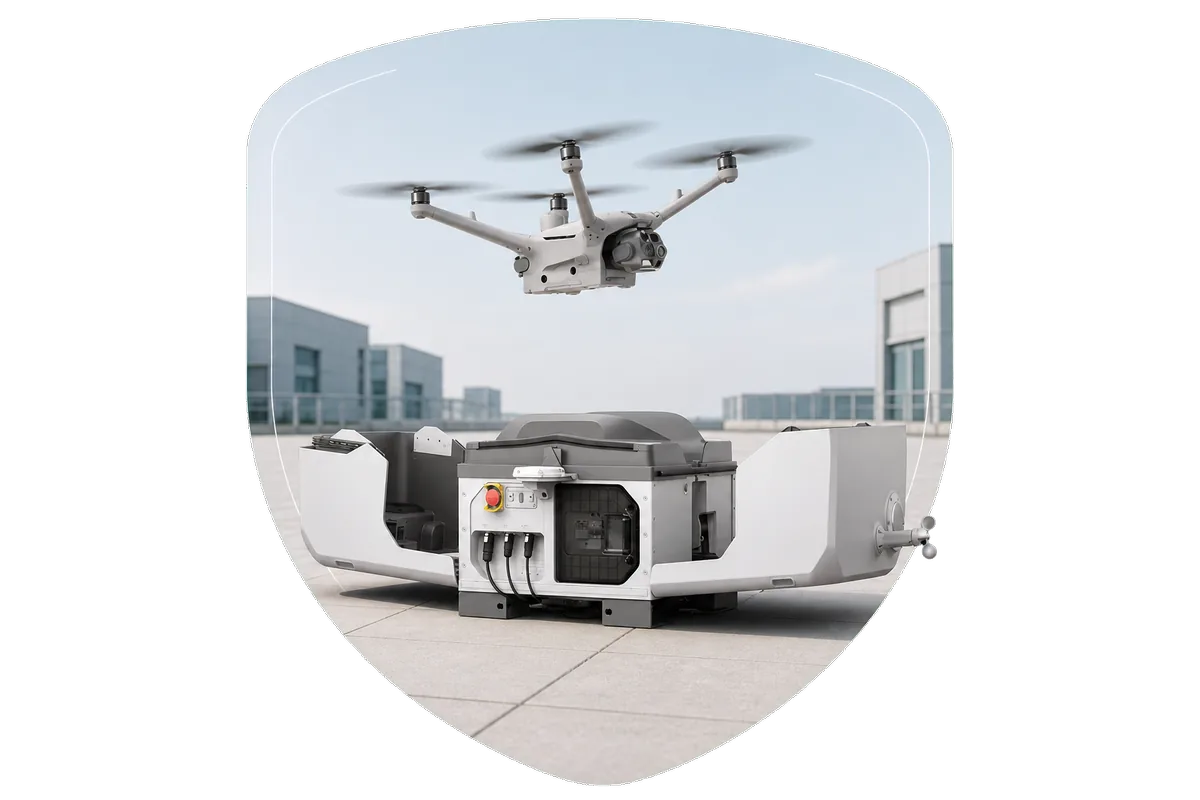
Aerial alarm verification — without travel time. AI-generated visualisation
Patrol and intervention — using a solar park as an example.
Large sites such as solar parks, substations or energy facilities are difficult to monitor comprehensively with stationary technology alone. The autonomous drone adds a mobile perspective to perimeter protection — scheduled for routine operations and immediately available when an alarm occurs.
The drone flies predefined routes along the perimeter on a scheduled, repeatable and documented basis. It reports anomalies directly to the control room.
When fence sensors or video analytics trigger an event, the drone launches for the alarm location after approval. Live and thermal imagery are available before personnel enter the site.
How an automated mission works.
Five steps from the initial alert to documented evidence — rule-based and governed by control-room approval.
Alarm
A sensor, fence system or report triggers an incident.
Approval
The control room reviews and approves the mission.
Launch
The drone launches automatically from the dock.
Live view
RGB and thermal imagery reach the control room in real time.
Evidence
The situation is documented for records and response.
Mobile multisensor technology meets automated dock operation.
Drone benefits
Matrice 4TD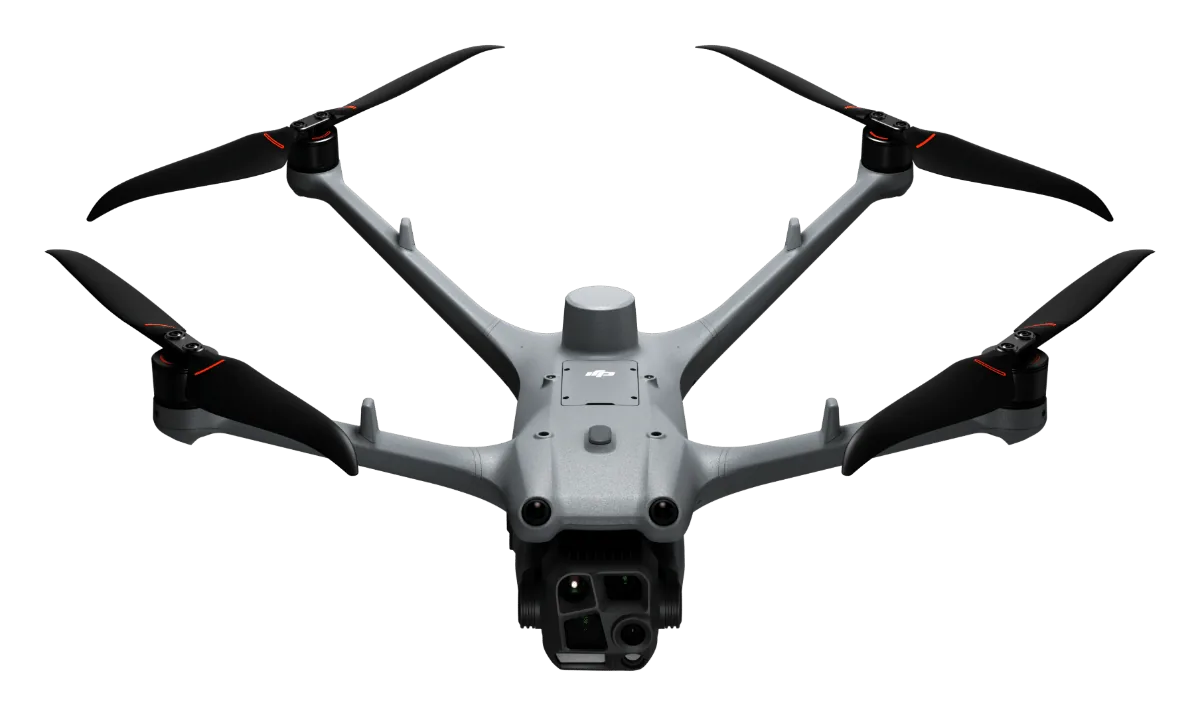
Rapid initial assessment
Verify an alarm location without travel time.
Mobile multisensor platform
Combine RGB, thermal, NIR and laser sensing.
Flexible perspective
Adapt altitude, viewing direction and zoom.
Safer remote reconnaissance
Inspect hazardous areas before deploying personnel.
Dock benefits
DJI Dock 3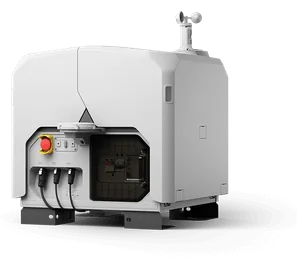
Automated operation
Launch, landing, charging and system checks.
High availability
Climate, weather and condition monitoring.
Alarm and scheduled missions
Rule-based and governed by approval logic.
Control-room ready
Telemetry, live video, APIs and mission data.
Key figures for an authorisable security operation.
Integrated Matrice 4TD sensors
Three 48 MP cameras
24 mm wide angle · 70 mm tele · 168 mm tele
Thermal imaging
640 × 512 native · UHR output up to 1280 × 1024
Night and distance
NIR auxiliary light up to 100 m · laser up to 1,800 m
Positioning in the high-end segment.
An indicative comparison with common high-end security drones — to be validated in a real PoC before procurement.
* Technical BVLOS suitability does not replace an operating authorisation. Privacy masking and the VMS/video gateway must be validated at software level in the PoC. Rating: 1 = weak/unclear, 5 = strong.
Legal, site, IT and operational requirements must work together.
A dock system is not an autonomous device without an operator. We assess and plan the requirements together with you.
Aviation law and operator
- Operator registration, UAS liability insurance and geo-zone review
- Remote-pilot qualification, operations manual and emergency procedures
- BVLOS in the Specific category — C6 alone is not an operating authorisation
Site and construction
- Foundation approx. 700 × 700 × 100 mm, C25 concrete, level and drained
- Level tolerance ±4 mm, slope below 3°, load capacity ≥ 100 kg/m²
- Clear arrival and departure zone; work area > 1.9 m, lateral clearance > 0.6 m
Power, network and availability
- 100–240 V AC, customer-side supply > 1,000 W, separate 16 A protection
- Cat 6 LAN preferred; cellular or 5G as an independent backup path
- Surge protection, grounding, UPS, monitoring and a defined restart process
Privacy, IT and video
- Geocaging and privacy masking for property boundaries and neighbouring areas
- MFA, roles, audit logs, encryption, short retention periods and deletion
- Validate APIs, VMS integration and the video gateway in a real PoC
Operations, maintenance and emergency management
- Check go/no-go status, weather, battery, link and GNSS/RTK before every mission
- Training, test flights and documented maintenance records
- Emergency procedures for RTH, link loss and alternative landing
Important notice
Purchasing a dock solution does not automatically authorise autonomous flight operations. Before commissioning, the site, operator organisation, privacy safeguards, IT integration and aviation-law requirements must be assessed and approved. Manufacturer specifications are maximum values; operations must allow reserves for the return flight, wind, temperature, communications, landing and battery ageing.
Security drones in practical operation
Key questions about operation, authorisation and integration.
Which tasks can autonomous security drones perform?
They can fly to approved alarm locations, carry out scheduled patrols and transmit RGB and thermal imagery to a control room for verification. The operating model depends on the site, risk concept and authorisation.
May a drone-in-a-box fly automatically beyond visual line of sight?
Not on the basis of the technology or a C6 marking alone. BVLOS operations generally fall within the Specific category and require an assessed operating concept and the necessary authority approval.
Can drones be integrated with existing security platforms?
Yes. Depending on the project, mission data, live video and events can be connected to VMS, PSIM and control-room systems through APIs, video gateways or partner integrations.
How should a security-drone trial begin?
It starts with a site and requirements assessment. Airspace, alarm workflows, privacy, IT integration, emergency procedures and success criteria are then defined for a limited proof of concept.
PoC trial
Request a PoC trial for your site
Briefly describe your site, the planned deployment and your requirements. We will review the framework conditions and get back to you with a suitable next step.